- Home
- /
- Officials, Umpires &...
- /
- Gold, silver and...
Gold, silver and bronze: Kiwis collect the set in Switzerland

Rapid rise continues for rookie New Zealand crews at World Cup Lucerne.
Six days ago, Logan Ullrich was posting scores from an erg session in which he destroyed his Concept 2 over 6km, 4km and 2km pieces in quick succession.
The 2K alone, was scary - the Olympic silver medallist from the Men's Four in Paris clocking 5.58.5 at 24 rating.
For his next trick...the athlete who's had just six races at international level in the Single Sculls went out and won gold at the latest World Cup event in Switzerland.
It was a successful day across the board for the New Zealand squad, winning silver in the Men's Pair and Men's Double Sculls and bronze in the Women's Four.
Strength alone won't win medals in the Single Sculls. Technical prowess and an ability to learn quickly play an equally big part. Ullrich showed all those attributes to no better effect than in the last quarter of his medal race on the Rotsee course in Switzerland overnight NZT.
He was more than two seconds down on Olympic silver medallist in the Single, Yauheni Zalaty, and in fourth place with 500m to go.
He dropped Germany's Marc Weber and Norway's Jonas Juel around the 1750m mark then went to work on Zalaty, the most renowned sprinter in world rowing.
Ullrich won in 6.44.92, with Zalaty crossing in 6.45.21.
"I've dreamed about this for years," he told World Rowing. "I didn't think it would come this quickly in my sculling career, I'm just blown away."
Coach Mike Rodger, who mentored Emma Twigg to her successful Olympic campaigns, was also blown away by Ullrich's rapid rise.
"He's phenomenal," said Rodger. "You've got to remember he hasn't really rowed a single at all but because he's so green, he just takes everything in, listens and makes the changes."
Rodger praised Ullrich's willingness to reframe his race strategy.
"He likes to do what he calls a U-shaped race plan, quick out of the blocks, pace it through the middle and go again at the end. Coming out of the blocks as hard as he did in the World Cup event in Varese, it's doing a max 500 metre then having to throw another 1500 metres on it, and then another minute because the single takes seven minutes."
So they flattened the U to give him "a bit more gas in the middle" to keep in contact and then launch.
In two short weeks Ullrich has gone from B-Final winner to sculling's A-list.

Logan Ullrich claims gold crossing the line in 6.44.92 in the men's single sculls A Final.
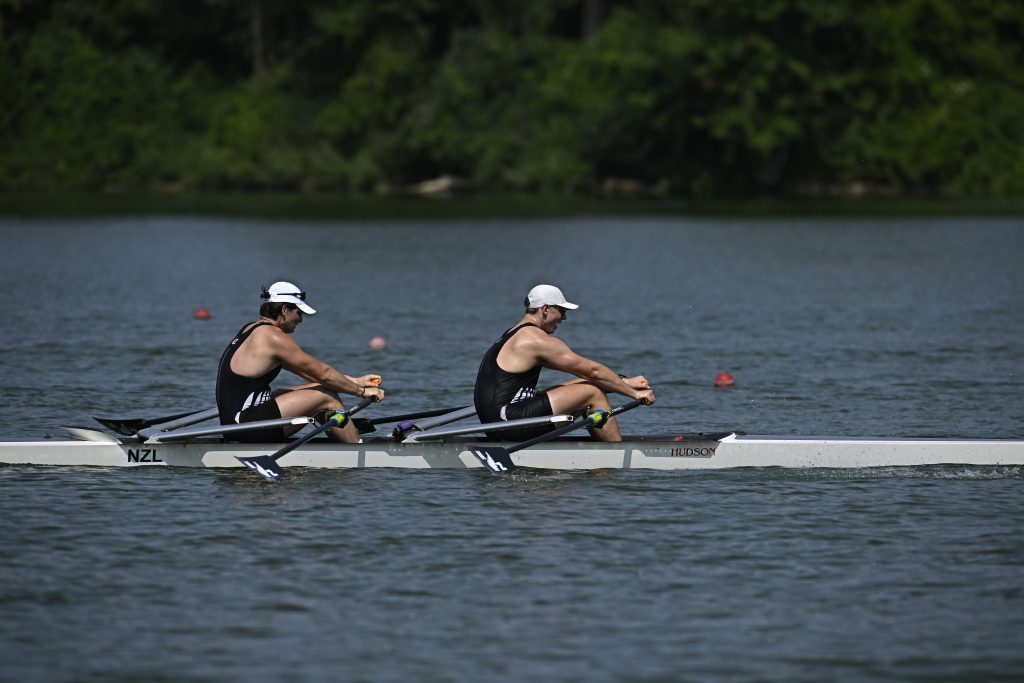
Ben Mason and Finn Hamill again showed their ability to attack over the second half of the race to win silver in the Men's Double.
The duo had only raced together three times before this weekend but are now being talked about as one of the crews to watch ahead of the World Championships in China in September.
The New Zealanders had moved into second at the 1000m mark, just 0.96s behind the Ireland crew that included two-time Olympic gold medallist Fintan McCarthy.
From there it was attack, and attack again, Mason and Hamill hunting the Irish down through the final 250m. Serbia were also charging late and only a photo finish could separate the two leading crews. Serbia took it in 6.10.48, New Zealand crossing in 6.10.53.
"I remember looking over with 150 to go and thinking, 'Oh my God, we're actually going to win this," says Mason. "So we put the foot down...we were sprinting well, we were on great numbers. And then I just couldn't believe the Serbians were able to get in front...hats off to them with how fast they sprinted because we were actually flying at the end there."

Ben Mason (left) and Finn Hamill (right) again showed their ability to attack over the second half of the race to win silver in the Men's Double.
Men's Pair Ben Taylor and Oli Welch got their head-to-head with Romania's experienced combination of Florin Lehaci and Florin Arteni, the current European champions and 2024 Olympic finalists in not only the Pair but the Men's Eight as well.
It was a two-boat race for gold with Taylor and Welch leading by just 0.02 seconds through the first 500m. The Romanians squeezed out to lead at 800m and their margin was just 0.26s at the 1000m. They extended through the third 500m, eventually winning in 6.17.57. Taylor and Welch took silver in 6.20.14.

The Men's Pair of Ben Taylor (left) and Oli Welch (right) took silver after a battle with Romania's experienced combination of Florin Lehaci and Florin Arteni, the current European champions and 2024 Olympic finalists.
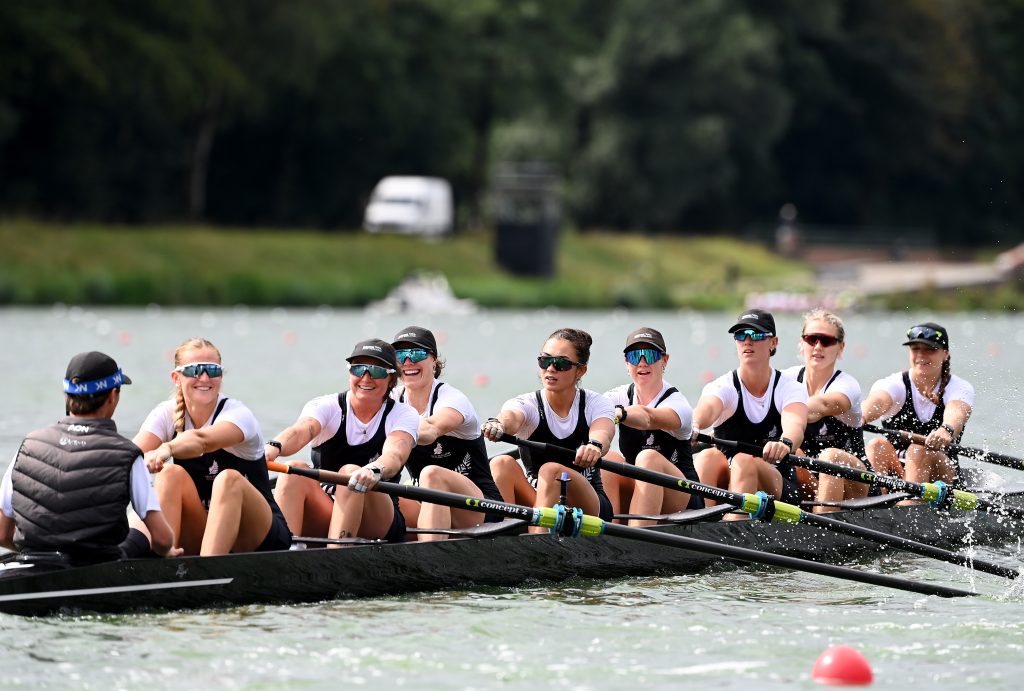
One of the highlights of the weekend was the progress of the Women's Four in winning bronze. They've had a disrupted start to their campaign with bow seat Juliette Lequeux unable to row at World Cup Varese because of illness.
She said they'd stepped up on their row in the heats.
"We fell apart a bit in the last 750 on Friday," says Lequeux.
"We decided to sit on our rhythm the whole race today. After our start, we sat one split lower than Friday and it just felt easy because we did it all together."
The US won in 6.21.31, Australia just held on for second (6.24.13), with New Zealand crossing in 6.24.56.

The Women's Four (pictured from left to right) Alana Sherman, Isla Blake, Juliette Lequeux and Beckie Leigh claimed bronze. The US won in 6.21.31, Australia just held on for second (6.24.13), with New Zealand crossing in 6.24.56.
It will go down as a significant day for the Men's Four of Flynn Eliadis-Watson, Campbell Crouch, Zack Rumble and Josh Vodanovich.
They produced their best start of the regatta to lead at the 500m.
"We've always been like half a length or a length behind," says Crouch. "The defining moment was probably the 750 where we just wanted to push away and then push away again at the 1k. It was pure determination to get what we wanted."
They were able to hold off a rapidly chasing pack to win the B Final in 6.00.27, ahead of Great Britain (6.01.96) and Uzbekistan (6.03.15).
Vodanovich is in his first season at Elite level. Rumble and Eliadis-Watson rowed two races at the Final Olympic qualifier in the Quad last year and Eliadis-Watson raced at that year's World Cup III; Crouch also debuted in 2024. All up, they tallied just 24 races between them at this level before arriving in Lucerne.
Compare that to the New Zealand Men's Four that won silver at the Paris Olympics, who between them had 111 in total by the time they got to the Vaire-sur-Marne course.
Rowing New Zealand's Athlete Performance Lead Justin Evans is excited by the crew's momentum given their relative inexperience.
"Yeah, Ollie [Maclean] and Logan [Ullrich] hadn't had much elite experience beforehand but you had Tom Murray who had been in the team since the Rio cycle and Matt Macdonald coming in for the Tokyo cycle so there's a lot for this group to learn without having the experience of athletes like that to pass their knowledge on.
"Their result is great motivation to keep pushing every day ahead of the Worlds in China."

The Men's Four of Flynn Eliadis-Watson (s), Campbell Crouch, Zack Rumble and Josh Vodanovich were able to hold off a rapidly chasing pack to win the B Final in 6.00.27, ahead of Great Britain (6.01.96) and Uzbekistan (6.03.15).
Stella Clayton-Greene and Kathryn Glen are also on that learning trajectory in their first season together since winning bronze in the Double Sculls at the U19 World Championships in 2018.
The standard at Elite level means for brutal and unforgiving racing across the field.
Some top crews were squeezed out of the A Final, which turned the B Final into a classic - with less than two seconds separating the top five crews going through the 1500m. Any of them could have got up for the win but in the end that was Switzerland in 6.57.69. Clayton-Greene and Glen finished fourth in 6.59.92.

The women's double of Stella Clayton-Greene and Kathryn Glen finished fourth in the B final after a close race crossing the line in 6.59.92. There was less than two seconds separating the top five crews going through the 1500m.
The weekend's also been a landmark occasion for New Zealand umpire Sophie Strachan, at her first World Rowing event.
Over the three days she's been on the water, boat and coxswain weighing, control commission and at the finish.
"The judging has been challenging for everyone," says Strachan. "Because the new progression system has changed, a lot of the racing is very close [with] a lot of lead changes in the last 250 metres, some of it's just so close.
"You have systems and your backup system so it's all fine. But when you are the caller, you want to get it in the right order."
It's all systems go as far as the Kiwis are concerned.

Andy Hay
Andy Hay is a freelance producer, writer and Maadi Cup-winning coach. He was cox of the world champion New Zealand eight of 1982 and '83. He is NZ Olympian #446.
Share Story

- Home
- /
- Officials, Umpires &...
- /
- Gold, silver and...
Gold, silver and bronze: Kiwis collect the set in Switzerland
Rapid rise continues for rookie New Zealand crews at World Cup Lucerne.
Six days ago, Logan Ullrich was posting scores from an erg session in which he destroyed his Concept 2 over 6km, 4km and 2km pieces in quick succession.
The 2K alone, was scary - the Olympic silver medallist from the Men's Four in Paris clocking 5.58.5 at 24 rating.
For his next trick...the athlete who's had just six races at international level in the Single Sculls went out and won gold at the latest World Cup event in Switzerland.
It was a successful day across the board for the New Zealand squad, winning silver in the Men's Pair and Men's Double Sculls and bronze in the Women's Four.
Strength alone won't win medals in the Single Sculls. Technical prowess and an ability to learn quickly play an equally big part. Ullrich showed all those attributes to no better effect than in the last quarter of his medal race on the Rotsee course in Switzerland overnight NZT.
He was more than two seconds down on Olympic silver medallist in the Single, Yauheni Zalaty, and in fourth place with 500m to go.
He dropped Germany's Marc Weber and Norway's Jonas Juel around the 1750m mark then went to work on Zalaty, the most renowned sprinter in world rowing.
Ullrich won in 6.44.92, with Zalaty crossing in 6.45.21.
"I've dreamed about this for years," he told World Rowing. "I didn't think it would come this quickly in my sculling career, I'm just blown away."
Coach Mike Rodger, who mentored Emma Twigg to her successful Olympic campaigns, was also blown away by Ullrich's rapid rise.
"He's phenomenal," said Rodger. "You've got to remember he hasn't really rowed a single at all but because he's so green, he just takes everything in, listens and makes the changes."
Rodger praised Ullrich's willingness to reframe his race strategy.
"He likes to do what he calls a U-shaped race plan, quick out of the blocks, pace it through the middle and go again at the end. Coming out of the blocks as hard as he did in the World Cup event in Varese, it's doing a max 500 metre then having to throw another 1500 metres on it, and then another minute because the single takes seven minutes."
So they flattened the U to give him "a bit more gas in the middle" to keep in contact and then launch.
In two short weeks Ullrich has gone from B-Final winner to sculling's A-list.
Logan Ullrich claims gold crossing the line in 6.44.92 in the men's single sculls A Final.
Ben Mason and Finn Hamill again showed their ability to attack over the second half of the race to win silver in the Men's Double.
The duo had only raced together three times before this weekend but are now being talked about as one of the crews to watch ahead of the World Championships in China in September.
The New Zealanders had moved into second at the 1000m mark, just 0.96s behind the Ireland crew that included two-time Olympic gold medallist Fintan McCarthy.
From there it was attack, and attack again, Mason and Hamill hunting the Irish down through the final 250m. Serbia were also charging late and only a photo finish could separate the two leading crews. Serbia took it in 6.10.48, New Zealand crossing in 6.10.53.
"I remember looking over with 150 to go and thinking, 'Oh my God, we're actually going to win this," says Mason. "So we put the foot down...we were sprinting well, we were on great numbers. And then I just couldn't believe the Serbians were able to get in front...hats off to them with how fast they sprinted because we were actually flying at the end there."
Ben Mason (left) and Finn Hamill (right) again showed their ability to attack over the second half of the race to win silver in the Men's Double.
Men's Pair Ben Taylor and Oli Welch got their head-to-head with Romania's experienced combination of Florin Lehaci and Florin Arteni, the current European champions and 2024 Olympic finalists in not only the Pair but the Men's Eight as well.
It was a two-boat race for gold with Taylor and Welch leading by just 0.02 seconds through the first 500m. The Romanians squeezed out to lead at 800m and their margin was just 0.26s at the 1000m. They extended through the third 500m, eventually winning in 6.17.57. Taylor and Welch took silver in 6.20.14.
The Men's Pair of Ben Taylor (left) and Oli Welch (right) took silver after a battle with Romania's experienced combination of Florin Lehaci and Florin Arteni, the current European champions and 2024 Olympic finalists.
One of the highlights of the weekend was the progress of the Women's Four in winning bronze. They've had a disrupted start to their campaign with bow seat Juliette Lequeux unable to row at World Cup Varese because of illness.
She said they'd stepped up on their row in the heats.
"We fell apart a bit in the last 750 on Friday," says Lequeux.
"We decided to sit on our rhythm the whole race today. After our start, we sat one split lower than Friday and it just felt easy because we did it all together."
The US won in 6.21.31, Australia just held on for second (6.24.13), with New Zealand crossing in 6.24.56.
The Women's Four (pictured from left to right) Alana Sherman, Isla Blake, Juliette Lequeux and Beckie Leigh claimed bronze. The US won in 6.21.31, Australia just held on for second (6.24.13), with New Zealand crossing in 6.24.56.
It will go down as a significant day for the Men's Four of Flynn Eliadis-Watson, Campbell Crouch, Zack Rumble and Josh Vodanovich.
They produced their best start of the regatta to lead at the 500m.
"We've always been like half a length or a length behind," says Crouch. "The defining moment was probably the 750 where we just wanted to push away and then push away again at the 1k. It was pure determination to get what we wanted."
They were able to hold off a rapidly chasing pack to win the B Final in 6.00.27, ahead of Great Britain (6.01.96) and Uzbekistan (6.03.15).
Vodanovich is in his first season at Elite level. Rumble and Eliadis-Watson rowed two races at the Final Olympic qualifier in the Quad last year and Eliadis-Watson raced at that year's World Cup III; Crouch also debuted in 2024. All up, they tallied just 24 races between them at this level before arriving in Lucerne.
Compare that to the New Zealand Men's Four that won silver at the Paris Olympics, who between them had 111 in total by the time they got to the Vaire-sur-Marne course.
Rowing New Zealand's Athlete Performance Lead Justin Evans is excited by the crew's momentum given their relative inexperience.
"Yeah, Ollie [Maclean] and Logan [Ullrich] hadn't had much elite experience beforehand but you had Tom Murray who had been in the team since the Rio cycle and Matt Macdonald coming in for the Tokyo cycle so there's a lot for this group to learn without having the experience of athletes like that to pass their knowledge on.
"Their result is great motivation to keep pushing every day ahead of the Worlds in China."
The Men's Four of Flynn Eliadis-Watson (s), Campbell Crouch, Zack Rumble and Josh Vodanovich were able to hold off a rapidly chasing pack to win the B Final in 6.00.27, ahead of Great Britain (6.01.96) and Uzbekistan (6.03.15).
Stella Clayton-Greene and Kathryn Glen are also on that learning trajectory in their first season together since winning bronze in the Double Sculls at the U19 World Championships in 2018.
The standard at Elite level means for brutal and unforgiving racing across the field.
Some top crews were squeezed out of the A Final, which turned the B Final into a classic - with less than two seconds separating the top five crews going through the 1500m. Any of them could have got up for the win but in the end that was Switzerland in 6.57.69. Clayton-Greene and Glen finished fourth in 6.59.92.
The women's double of Stella Clayton-Greene and Kathryn Glen finished fourth in the B final after a close race crossing the line in 6.59.92. There was less than two seconds separating the top five crews going through the 1500m.
The weekend's also been a landmark occasion for New Zealand umpire Sophie Strachan, at her first World Rowing event.
Over the three days she's been on the water, boat and coxswain weighing, control commission and at the finish.
"The judging has been challenging for everyone," says Strachan. "Because the new progression system has changed, a lot of the racing is very close [with] a lot of lead changes in the last 250 metres, some of it's just so close.
"You have systems and your backup system so it's all fine. But when you are the caller, you want to get it in the right order."
It's all systems go as far as the Kiwis are concerned.
Andy Hay
Andy Hay is a freelance producer, writer and Maadi Cup-winning coach. He was cox of the world champion New Zealand eight of 1982 and '83. He is NZ Olympian #446.