- Home
- /
- School Rowing
- /
- Coaches and Parents...
Coaches and Parents Share Tips to Help Novice Rowers Stay Balanced and Build Confidence
The Novice rower faces a multitude of challenges as “a newbie” to the sport of rowing. We speak to a pair of coaches and two parents to hear their thoughts and learnings on how to smooth the path for any first-year rower
The Coaches
Steve Finlayson – The Director of Rowing at Mount Albert Grammar School, Auckland
Harry Williams – Currently novice coach at St Peter’s College, Auckland.
What is the most technical habit a novice rower should focus on developing early, and why?
Steve Finlayson: For a novice, the single most important technical habit to focus on is learning good stroke sequence (legs first, then body, then arms) on the drive, and the reverse on the recovery. This sequence is the foundation of everything in rowing. If a rower pulls too early with their arms or leans back (opens up) too soon with their body, the boat loses balance and speed.
We focus on helping our novices understand how their movement impacts the rhythm of the boat. When rowers first start rowing, it's more important to be smooth and coordinated than fast and strong. When they get the sequence and timing right, and they can move together as a crew, the boat runs better and it becomes more enjoyable.

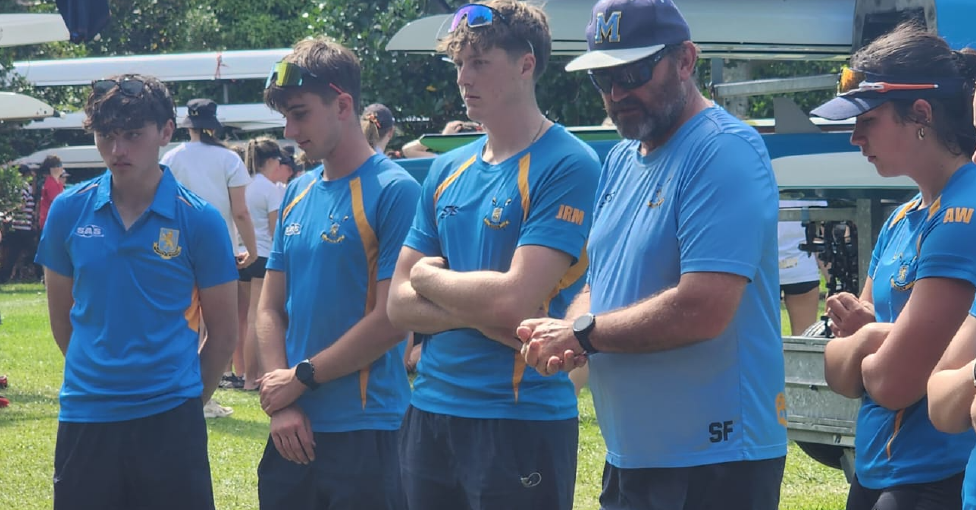
Coach Steve Finlayson in action with his Mount Albert Grammar Schools novice rowers.
Harry Williams: There are two areas I believe each novice rower should learn to develop early. The number one is sequence in the recovery (separation). The arms should get out long in front of the body, then the body should rock over from your hips while keeping the back straight. By this stage, the hands should be just past the knees, which is when you can lift your knees up to bring yourself to the catch in a strong position.
The second area is core strength. Having solid core strength allows you to sit strong in the boat, prevents injury and will mean you are able better transfer your power in the drive phase. Completing ten minutes of core work every night is all you need to see substantial improvements.

St Peter's College, Auckland Coach Harry Williams sees separation and core strength as key things a novice rower should work on early.
What is the most common mistake you see novice rowers make, and how can they correct it?
Steve Finlayson: The most common mistake is trying to do too much too soon. Novice rowers often think that pushing harder or going faster will make the boat go quicker, but that usually doesn't work. It can throw off timing, make the boat unbalanced, and slow things down. By trying too hard they might also rush the recovery or forget the correct sequence.
The way to correct this is to slow the stroke down and focus on the technical basics. Pay attention to rhythm, sequencing, and balance in the boat. Learning to row smoothly and in sync with your crew mates will get the boat moving faster than effort alone.
Focusing on one thing at a time really helps novices improve and not get overwhelmed. As the technical habits become second nature, speed will come on top of that solid technical foundation.
Harry Williams: The most common mistake novices make is blade work, especially at the catch. Quite often rowers will be told that they are skying their blades at the catch. This is because they are carrying their handles to low, which causes them to miss the catch completely. Focusing on keeping the eyes, chest and hands up will mean you arrive at the catch with a better blade pathway and will be in a much stronger position. Poor bladework can also be caused by bad posture in the boat. Rowers should focus on sitting tall on their glutes and keeping their back straight with their core engaged. Doing this will also help you improve your bladework.
What advice would you give novice rowers to help them improve consistently without getting discouraged?
Steve Finlayson: Everyone starts at the same level and that progress in rowing isn’t linear. Some sessions will feel great and others won’t, and that’s completely normal. Early on, it’s not about how fast the boat goes or where they place at a regatta. It’s about learning the skills, getting comfortable in the boat, and understanding how rowing works.
In our novice programme, we put a lot of emphasis on enjoyment and learning in a low-pressure environment. If a rower turns up consistently, listens to feedback, and focuses on one or two simple things each session, they will improve. Having fun with their teammates, supporting each other, not comparing themselves to others, all make a big difference. If they enjoy the process and keep showing up, confidence and performance end up taking care of themselves.
Harry Williams: It is important for novice rowers to understand that technical changes are not going to be made instantly, but instead over months of completing sessions to the best of their ability. Have the mindset to stack up the “small wins”. This could be a coach sharing positive feedback, gaining a PB on the erg or even completing a hard session on or off the water. Focusing on attaining those small wins each session will
allow you to stay optimistic and build your confidence over time. Soon the small wins, will turn into big wins.
The Parents
Jo Simpkins – Is a mum to two boys, Jack and Billy, who have rowed for St Peter’s College, Auckland. Her third son, Monty, is currently a coxswain at St Peter’s.
Steve Gough – Is a parent to three children, twin daughters, Sofia and Olivia and son, Max, currently part of the Mt Albert Grammar Rowing programme.
From a parent’s perspective, what advice would you give novice rowers about balancing rowing with school, rest, and other commitments?
Jo Simpkins: Plan your week. If you just freestyle your way through, you'll most likely find the balance will quickly wobble. If you just wing it, things like school, training, recovery, eating well, and having some personal downtime can quickly slip. Rowing training and competing takes up a huge chunk of time, so a little weekly planning goes a long way. Get into the habit of spending ten minutes mapping out the week ahead. Carve out some regular study times amongst your training schedule, spot the gaps where you can hang out with your mates online or off. Sunday evenings usually work well to plan the week ahead and mentally helps you feel more on top of things. And don’t forget to ask for help, when things start to feel a bit overwhelming check in with your coach, or the senior rowing captains who can offer some advice of how they find some balance.

Jo with her son's Billy (left) and Monty (right).
Steve Gough: Rowing is a great sport that gives kids a focus. They'll get physically strong and fit, learn how to work towards goals, and develop their interpersonal skills by spending so much time with others. It is also a physically demanding sport which is tiring in itself. This is accentuated by the fact there are often early starts and a lot of time spent travelling. Therefore, as a rower using your downtime well is important. You need to be organised to keep on top of other commitments. We use a weekly and season wall planner to help keep abreast of the weekly training programme and regattas/training camps. Nutrition is also critical – a rower will struggle to find energy to train effectively. With all the training you'll need to eat way more than you are used to. Take on board understand good advice on what type of foods to eat and when.
What do you think novice rowers (and their families) should know early on about the challenges and rewards of being involved in rowing?
Jo Simpkins: Rowing isn’t your typical school sport. It takes commitment and effort unlike anything else and challenges you both physically and mentally—but that’s part of what makes it so rewarding. And it’s not just about the rowers either. Parents play an important role and their support makes a big difference along the way - carpooling to training, supporting at regattas, and cooking up a mountain of carbs to make sure their novice rower has enough energy in the tank to train and compete at their best.
Your rowing squad quickly becomes one big team, across all age levels, with everyone looking out for each other. Because you spend so much time together at training, camps and competing, the sense of camaraderie is something special.
Along the way, novice rowers will build strength, discipline, resilience, and confidence, learning how to face challenges and push their limits. These aren’t just rowing skills—they’re also valuable life skills that stay with you long after you leave the boat.
Steve Gough: Rowing is time consuming and tough, so you need to manage your time carefully, although you’ll be amazed how much more you can do than you think you can! You get out of the sport what you put in. Yes, the coaches will support you but ultimately you are the only one who can make this happen.
The lessons you learn from rowing apply in all aspects of life – especially working consistently towards a goal. As a parent my main advice would be to get as involved as you can with the school programme. There are opportunities to contribute in many capacities. Through these you will get to know the other families involved and what the cadence of rowing is like and be a part of the success of your school programme.

Steve Landells
Steve Landells is an experienced communications specialist and sportswriter with more than 25 years' experience. He is currently a proud dad of a rower who competes for St Peter's College, Auckland.
Share Story

- Home
- /
- School Rowing
- /
- Coaches and Parents...
Coaches and Parents Share Tips to Help Novice Rowers Stay Balanced and Build Confidence
The Novice rower faces a multitude of challenges as “a newbie” to the sport of rowing. We speak to a pair of coaches and two parents to hear their thoughts and learnings on how to smooth the path for any first-year rower
The Coaches
Steve Finlayson – The Director of Rowing at Mount Albert Grammar School, Auckland
Harry Williams – Currently novice coach at St Peter’s College, Auckland.
What is the most technical habit a novice rower should focus on developing early, and why?
Steve Finlayson: For a novice, the single most important technical habit to focus on is learning good stroke sequence (legs first, then body, then arms) on the drive, and the reverse on the recovery. This sequence is the foundation of everything in rowing. If a rower pulls too early with their arms or leans back (opens up) too soon with their body, the boat loses balance and speed.
We focus on helping our novices understand how their movement impacts the rhythm of the boat. When rowers first start rowing, it's more important to be smooth and coordinated than fast and strong. When they get the sequence and timing right, and they can move together as a crew, the boat runs better and it becomes more enjoyable.
Coach Steve Finlayson in action with his Mount Albert Grammar Schools novice rowers.
Harry Williams: There are two areas I believe each novice rower should learn to develop early. The number one is sequence in the recovery (separation). The arms should get out long in front of the body, then the body should rock over from your hips while keeping the back straight. By this stage, the hands should be just past the knees, which is when you can lift your knees up to bring yourself to the catch in a strong position.
The second area is core strength. Having solid core strength allows you to sit strong in the boat, prevents injury and will mean you are able better transfer your power in the drive phase. Completing ten minutes of core work every night is all you need to see substantial improvements.
St Peter's College, Auckland Coach Harry Williams sees separation and core strength as key things a novice rower should work on early.
What is the most common mistake you see novice rowers make, and how can they correct it?
Steve Finlayson: The most common mistake is trying to do too much too soon. Novice rowers often think that pushing harder or going faster will make the boat go quicker, but that usually doesn't work. It can throw off timing, make the boat unbalanced, and slow things down. By trying too hard they might also rush the recovery or forget the correct sequence.
The way to correct this is to slow the stroke down and focus on the technical basics. Pay attention to rhythm, sequencing, and balance in the boat. Learning to row smoothly and in sync with your crew mates will get the boat moving faster than effort alone.
Focusing on one thing at a time really helps novices improve and not get overwhelmed. As the technical habits become second nature, speed will come on top of that solid technical foundation.
Harry Williams: The most common mistake novices make is blade work, especially at the catch. Quite often rowers will be told that they are skying their blades at the catch. This is because they are carrying their handles to low, which causes them to miss the catch completely. Focusing on keeping the eyes, chest and hands up will mean you arrive at the catch with a better blade pathway and will be in a much stronger position. Poor bladework can also be caused by bad posture in the boat. Rowers should focus on sitting tall on their glutes and keeping their back straight with their core engaged. Doing this will also help you improve your bladework.
What advice would you give novice rowers to help them improve consistently without getting discouraged?
Steve Finlayson: Everyone starts at the same level and that progress in rowing isn’t linear. Some sessions will feel great and others won’t, and that’s completely normal. Early on, it’s not about how fast the boat goes or where they place at a regatta. It’s about learning the skills, getting comfortable in the boat, and understanding how rowing works.
In our novice programme, we put a lot of emphasis on enjoyment and learning in a low-pressure environment. If a rower turns up consistently, listens to feedback, and focuses on one or two simple things each session, they will improve. Having fun with their teammates, supporting each other, not comparing themselves to others, all make a big difference. If they enjoy the process and keep showing up, confidence and performance end up taking care of themselves.
Harry Williams: It is important for novice rowers to understand that technical changes are not going to be made instantly, but instead over months of completing sessions to the best of their ability. Have the mindset to stack up the “small wins”. This could be a coach sharing positive feedback, gaining a PB on the erg or even completing a hard session on or off the water. Focusing on attaining those small wins each session will
allow you to stay optimistic and build your confidence over time. Soon the small wins, will turn into big wins.
The Parents
Jo Simpkins – Is a mum to two boys, Jack and Billy, who have rowed for St Peter’s College, Auckland. Her third son, Monty, is currently a coxswain at St Peter’s.
Steve Gough – Is a parent to three children, twin daughters, Sofia and Olivia and son, Max, currently part of the Mt Albert Grammar Rowing programme.
From a parent’s perspective, what advice would you give novice rowers about balancing rowing with school, rest, and other commitments?
Jo Simpkins: Plan your week. If you just freestyle your way through, you'll most likely find the balance will quickly wobble. If you just wing it, things like school, training, recovery, eating well, and having some personal downtime can quickly slip. Rowing training and competing takes up a huge chunk of time, so a little weekly planning goes a long way. Get into the habit of spending ten minutes mapping out the week ahead. Carve out some regular study times amongst your training schedule, spot the gaps where you can hang out with your mates online or off. Sunday evenings usually work well to plan the week ahead and mentally helps you feel more on top of things. And don’t forget to ask for help, when things start to feel a bit overwhelming check in with your coach, or the senior rowing captains who can offer some advice of how they find some balance.
Jo with her son's Billy (left) and Monty (right).
Steve Gough: Rowing is a great sport that gives kids a focus. They'll get physically strong and fit, learn how to work towards goals, and develop their interpersonal skills by spending so much time with others. It is also a physically demanding sport which is tiring in itself. This is accentuated by the fact there are often early starts and a lot of time spent travelling. Therefore, as a rower using your downtime well is important. You need to be organised to keep on top of other commitments. We use a weekly and season wall planner to help keep abreast of the weekly training programme and regattas/training camps. Nutrition is also critical – a rower will struggle to find energy to train effectively. With all the training you'll need to eat way more than you are used to. Take on board understand good advice on what type of foods to eat and when.
What do you think novice rowers (and their families) should know early on about the challenges and rewards of being involved in rowing?
Jo Simpkins: Rowing isn’t your typical school sport. It takes commitment and effort unlike anything else and challenges you both physically and mentally—but that’s part of what makes it so rewarding. And it’s not just about the rowers either. Parents play an important role and their support makes a big difference along the way - carpooling to training, supporting at regattas, and cooking up a mountain of carbs to make sure their novice rower has enough energy in the tank to train and compete at their best.
Your rowing squad quickly becomes one big team, across all age levels, with everyone looking out for each other. Because you spend so much time together at training, camps and competing, the sense of camaraderie is something special.
Along the way, novice rowers will build strength, discipline, resilience, and confidence, learning how to face challenges and push their limits. These aren’t just rowing skills—they’re also valuable life skills that stay with you long after you leave the boat.
Steve Gough: Rowing is time consuming and tough, so you need to manage your time carefully, although you’ll be amazed how much more you can do than you think you can! You get out of the sport what you put in. Yes, the coaches will support you but ultimately you are the only one who can make this happen.
The lessons you learn from rowing apply in all aspects of life – especially working consistently towards a goal. As a parent my main advice would be to get as involved as you can with the school programme. There are opportunities to contribute in many capacities. Through these you will get to know the other families involved and what the cadence of rowing is like and be a part of the success of your school programme.
Steve Landells
Steve Landells is an experienced communications specialist and sportswriter with more than 25 years' experience. He is currently a proud dad of a rower who competes for St Peter's College, Auckland.